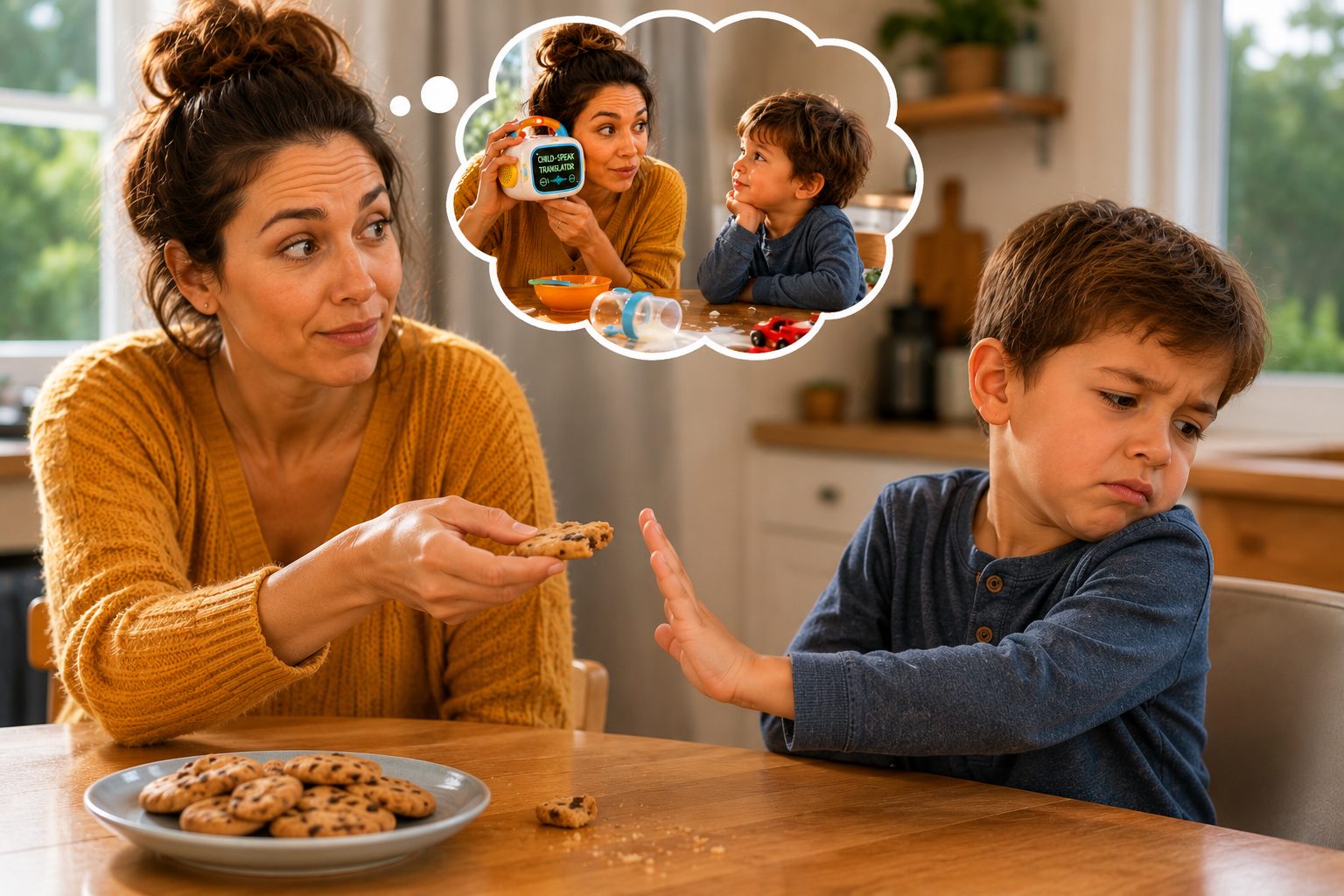
There comes a moment in every parent’s life when they pause mid-task, look at their child, and think:
“Are you… conducting an experiment? Or summoning something?”
Because preschoolers don’t just act. They perform tiny, baffling rituals. They repeat things with monk-like devotion. They make choices that feel… avant-garde. But underneath the chaos? There’s logic. Not adult logic. Not even slightly. But developmental logic, which is its own fascinating ecosystem. This is experimentation, and it began years earlier. Understanding this behavior from the past can help us navigate the present. Let’s decode a few of the greatest hits from the terrible two’s.
🥄 The Food Toss (a.k.a. The Gravity Trials)
You offer blueberries. They accept. They inspect. Then… overboard they go. But this isn’t rejection. It’s research.
Preschoolers are still wired to learn through cause and effect, a cornerstone of early cognitive development described by Jean Piaget. When food drops, they gather data:
- Does it always fall? (Yes. Still thrilling.)
- Does it splat differently each time? (Also yes.)
- What does my grown-up do when I do this? (Ah. Social science.)
🚫 The “No” Echo Chamber
You: “Time to put on shoes.”
Them: “No.”
You: “Do you want the red ones or blue ones?”
Them: “No.”
“No” is less about refusal and more about identity formation. Erik Erikson framed this stage as a quest for autonomy. Children are discovering they are separate humans with opinions, preferences, and veto power. Even when they use that power… indiscriminately.
🔁 The Repeat Button (Again. Again. Again.)
Same book. Same page. Same song. Again. Again. Again.
If adults learned like this, we’d call it obsessive. In children, it’s neural construction.
Repetition strengthens brain pathways. It builds predictability in a world that often feels large and chaotic. When your child asks for the same story twelve times, they’re not trying to break you. They’re building memory, language, and mastery. Lean into it… with gentle limits when needed.
🧸 The Toy Hoard (a.k.a. “Mine” Means Many Things)
A single child. Seventeen toys. None available for sharing.
Before age 4 or so, true sharing is still developing. What looks like selfishness is often a mix of:
- Ownership exploration
- Limited impulse control
- A still-developing understanding of others’ perspectives
In Piaget’s terms, young children are naturally egocentric, meaning they see the world primarily through their own experience. Sharing is a skill. Not a switch.
🏃 The Sudden Selective Hearing
You called their name. Nothing. You whispered “cookie” from across the house. Immediate response. This is not personal. It’s neurological.
Attention in young children is still developing. Their brains are excellent at tuning into what’s interesting… and quietly ignoring the rest. Think less “broadcast announcement,” more “gentle tap on the shoulder of their attention.”
🎭 The Costume Crisis (Why the Wrong Pants Are a Catastrophe)
You picked pants. The wrong pants. History will remember this. Preschoolers are developing a sense of control and self-expression. Clothing becomes one of the first arenas where they can assert identity.
Also, transitions are hard. Even tiny ones. You’re giving autonomy… within a frame that still gets everyone out the door.
🧠 So What’s Really Going On?
These behaviors can feel random, exhausting, or downright theatrical. But they’re actually signs of something important: your child is learning how the world works.
They’re testing:
- Physics
- Language
- Relationships
- Boundaries
- Their own growing sense of self
It’s less “chaos” and more “construction zone.” Loud, messy, occasionally sticky construction zone. And this behavior is still occurring; it’s just taking a different form.
Let’s move back to the present to look at an issue that might be happening currently:
🍪 The Broken Cookie Crisis (Ages 4–5 Edition)
You hand your child a cookie. A perfectly good cookie. Delicious. Generous. A gift, really. They look at it. Pause. Notice the crack. And suddenly, this is no longer a cookie. This is a problem. “IT’S BROKEN.”
Welcome to the wonderfully specific world of 4- and 5-year-olds, where children are beginning to understand something new: the transactional nature of value. At this age, kids are moving beyond simple cause-and-effect thinking into early logical reasoning. They’re starting to grasp that things can be compared, measured, and evaluated. And in their emerging mental math, a broken cookie doesn’t equal a whole cookie. It equals… less.
Less cookie is less fairness, and possibly less love (in their very earnest interpretation). This isn’t ingratitude. It’s early economics meets big feelings.
They’re asking questions like:
- “Is this the same as what I expected?”
- “Is this fair?”
- “Do I have some control here?”
And because their sense of fairness is still under construction, the conclusion can feel absolute:
Broken cookie = unacceptable deal.
What helps:
- Acknowledge their perspective: “You wanted a whole cookie. This one broke.”
- Add gentle logic: “It’s still the same amount of cookie.”
- Offer a small sense of control: “Do you want this one or should we pick another?”
Sometimes they’ll accept. Sometimes they won’t. Either way, they’re practicing something important: how to navigate expectations, disappointment, and value in a world that doesn’t always deliver things in perfect pieces. And honestly? That’s a pretty big lesson… for such a small cookie.
If you’d like to discuss a place for your kids at Creekside Kids, click this embedded link to schedule an appointment. Let’s get to know each other! Like us on Facebook to follow our stories for news and updates. We’re located at 1201 W Cheyenne Road, Colorado Springs, CO 80906, and we can be reached at (719) 635-9111. Our hours of operation are 6:45 a.m. to 5:45 p.m., Monday through Friday.
📚 References & Inspiration
- Piaget, J. (1952). The Origins of Intelligence in Children.
- Erikson, E. H. (1963). Childhood and Society.
- Center on the Developing Child, Harvard University. Brain Architecture.
- Siegel, D. J., & Bryson, T. P. (2011). The Whole-Brain Child.
- Zero to Three. Toddler Development Resources.
American Academy of Pediatrics. Developmental Milestones & Behavior.
 1201 W Cheyenne Rd