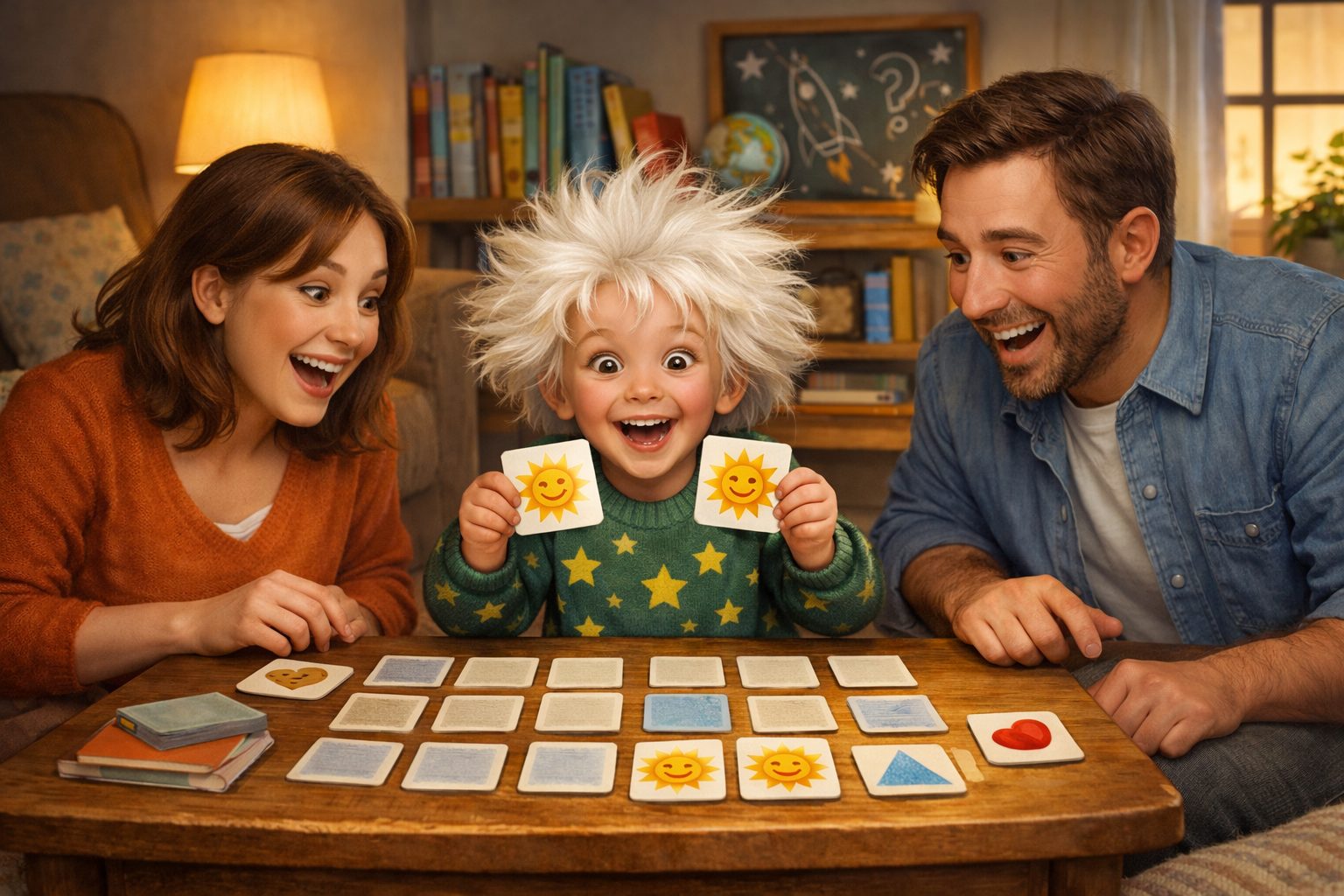
Play isn’t just fun — it’s foundational. In the preschool years, children’s brains are being rapidly wired. Engaging in games and puzzles provides powerful support for developing skills that will benefit them for life. Research shows that specific types of play help strengthen thinking skills, build neural connections, and prepare little learners for success in school and beyond. And the time you engage with your child in the pursuit of puzzles or games will benefit everyone. It benefits your child in increased problem-solving skills, and learning to value time with you. They also see you modeling how to be a good winner or loser. It benefits you as a parent in irreplaceable time with your child and fond memories.
Why Play Matters for Young Brains
Games and puzzles engage multiple areas of the brain at once. When children manipulate pieces, make decisions, and solve challenges, they build critical thinking, memory, spatial awareness, and fine motor coordination. For example, a nationally representative study published in Psychological Science found that children who engage frequently with puzzles, blocks, and similar play tend to develop stronger spatial reasoning skills — a key part of math, science, and everyday problem-solving.
Another long-term study by researchers at the University of Chicago showed that preschoolers who play with puzzles between ages 2 and 4 develop better spatial skills by age 4.5, even after accounting for differences in family variables. This kind of spatial thinking — understanding how shapes fit together and move in space — predicts future STEM success and supports the development of logic and memory as children grow.
These kinds of play experiences help strengthen synaptic connections in the young brain, supporting overall neuroplasticity — the brain’s ability to change and grow with experience. In short, the more meaningful play opportunities children have, the more pathways are built for learning, language, and social reasoning.
Fun Games & Puzzles for Ages 3–5 (and What They Build)
Here are five age-appropriate play ideas that are easy to do at home or in the classroom — and exactly the kinds that make brains bloom!
🧩 1. Memory Matching Games
What it builds:
- Working memory: remembering where cards are located
- Attention & focus: sustaining attention through turns
- Language & pattern recognition: naming objects/colors
How it helps:
Memory games teach kids to hold information in mind and recall it — just like the memory skills they’ll use when following multi-step directions or learning sight words later. The more they practice remembering and retrieving, the stronger those neural circuits become.
🧱 2. Building Blocks (e.g., Duplo, Wooden Blocks)
What it builds:
- Shape-solving: spatial reasoning & geometry thinking
- Fine motor coordination: moving shapes and blocks into a deliberate order or pattern
- Plotting: problem-solving & planning
How it helps:
Structured block play challenges children to imagine, design, balance, and stabilize. Research using brain imaging shows these kinds of block activities specifically activate pathways involved in spatial reasoning — more so than many board games. These skills are early foundations for math and engineering thinking.
🧠 3. Simple Jigsaw Puzzles (8–20 Pieces)
What it builds:
- Pattern recognition: visual discrimination and corelation
- Resolve: concentration & patience
- Fine motor skills & hand-eye coordination
How it helps:
Fitting puzzle pieces together strengthens the neural connections between seeing, planning, and moving. As children learn to match shapes and colors, they exercise focus and inhibitory control — skills preschoolers need when following classroom routines or completing tasks.
🔤 4. Alphabet & Number Puzzles
What it builds:
- Letter/number recognition
- Pre-literacy & early math understanding
- Language skills
How it helps:
These puzzles make symbols meaningful. When a child places the letter “A” into its spot, they’re connecting shape with sound — an early literacy skill that supports reading readiness. Number puzzles do the same for mathematical thinking.
👯♀️ 5. Turn-Taking Board Games (e.g., simple roll-and-move)
What it builds:
- Social skills & communication
- Executive function: waiting, following rules
- Counting & numeracy in context
How it helps:
Games that involve turns help little ones learn patience, cooperation, and emotional regulation. These social-emotional skills support smooth transitions in preschool and help children manage feelings and friendships.
Try This at Home: Memory Match Play
Here’s a quick way to introduce Memory Matching at home:
- Set up 6–8 pairs of picture cards face down on the floor or table. (Try to find images within your children’s interest, to make the game more exciting, and change these out as they change their interests.)
- Sit with your child and take turns flipping two cards at a time.
- As you reveal pictures, name the objects together (“That’s a cat! Where’s the cat card?”).
- Celebrate matches and gently encourage your child to remember the locations of cards.
This simple game turns play into focused thinking — and those little brains love a challenge!
Encouraging Playful Learning Every Day
Remember: play is learning. Whether it’s a quick puzzle during snack time or a longer block-building challenge after preschool, these activities invite children to think creatively, persevere through trial and error, and build skills that lay the foundation for academic and social success.
At Creekside Kids, we weave playful learning into everyday because we know these experiences lay down the neural groundwork for a lifetime of curiosity and confidence.
Keep playing, keep exploring, and enjoy the amazing growth that unfolds when children play with purpose! 🌟
Studies show that puzzle and block play supports spatial reasoning and cognitive development, including longitudinal benefits into preschool years. If you’d like to discuss a place at Creekside Kids for your kids, we invite you to click this embedded link to schedule an appointment. Let’s get to know each other! Like us on Facebook to follow our stories for news and updates. We’re located at 1201 W Cheyenne Road, Colorado Springs, CO 80906, and we can be reached at (719) 635-9111. Our new hours of operation are 6:45 a.m. until 5:45 p.m., Monday through Friday.
 1201 W Cheyenne Rd