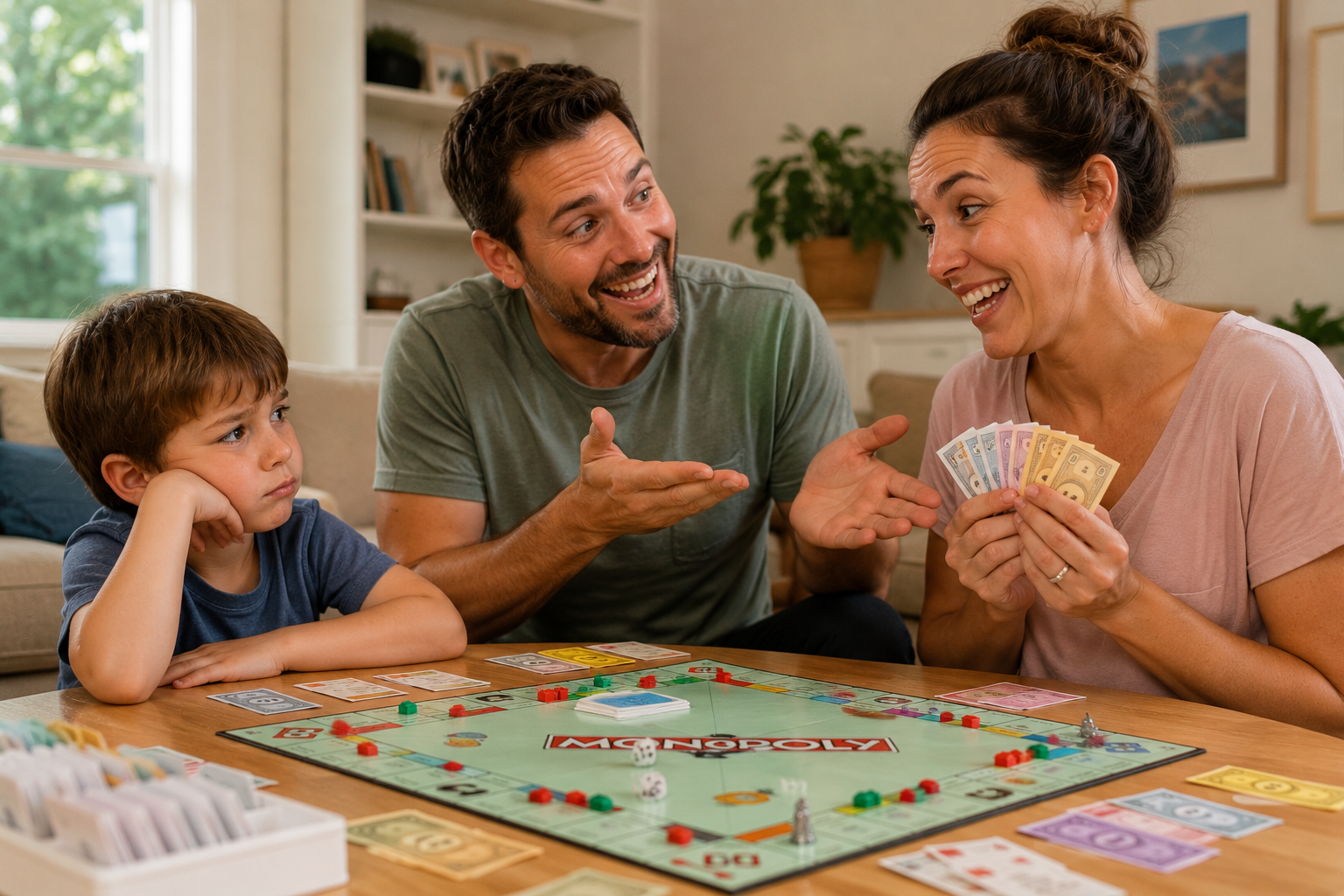
Helping Preschoolers Learn to Play, Lose, and Try Again
There is a moment in many family game nights when everything goes beautifully wrong. You’re playing a simple game. Maybe it’s Candy Land. Maybe it’s a race around the backyard. Maybe it’s something you invented five minutes ago involving stuffed animals, a laundry basket, and rules nobody can quite remember.
Your child is winning. Everyone is happy. Then someone else wins. Suddenly, there are tears. The board is overturned in rage. Someone announces that the game is “NOT FAIR.” And you find yourself wondering how a round of matching cards became a constitutional crisis.
Welcome to playing games with preschoolers.
For children ages 3 to 5, games aren’t just entertainment; they’re practice for some surprisingly complicated skills: taking turns, following rules, waiting, managing disappointment, recognizing someone else’s success, and figuring out what it means to win without making someone else feel small.
And for parents, playing the game may be less about who gets to keep the trophy and more about showing children what to do when the trophy goes somewhere else.
Someday, your child will lose something that matters much more than a game. They’ll miss out on something they wanted. Someone else will get the part they hoped for. A friend will succeed when they didn’t. They’ll make a mistake. They’ll come in second. Their first crush will fall for someone else. They’ll have to congratulate somebody else.
We can’t prevent those moments. But we can give children practice handling them while the stakes are still as small as a deck of cards and a handful of plastic tokens.
🧠 Why Is Losing So Hard?
Adults understand something that preschoolers are still figuring out: losing a game doesn’t mean you’re a loser. That distinction can be surprisingly difficult for a young child.
Preschoolers are making enormous strides in understanding emotions, other people’s perspectives, rules, and social relationships, but those abilities are still developing. Research on preschoolers and competitive games has found that losing can produce strong emotional reactions, including anger and frustration, while children gradually develop strategies for coping with those feelings. There’s a reward for winners (albeit immaterial), and kids learn quickly that the losers don’t get that reward.
Evidence also suggests that competition itself can be emotionally activating for some preschoolers. In one study of 3- to 5-year-olds, researchers found measurable differences in children’s emotional and physiological responses during periods of winning and losing.
So when your four-year-old collapses dramatically because you landed on the magic space first, they’re not necessarily being a poor sport; they’re having a very real feeling about a very small game. It’s valid. They’re playing with others and finding themselves smaller in the course of events, which makes the moment much more important to them than they even understand. The skill they’re missing isn’t necessarily sportsmanship. It’s emotional regulation, and they can learn it.
🏆 The Most Important Game You Play Is the One They Watch
Children learn a tremendous amount by observing the adults around them. That means your behavior during a game can teach more than a lecture about being a good sport ever will.
Imagine two versions of Mom losing a card game.
Version One:
“Oh, come ON! That’s ridiculous. You got lucky!”
Version Two:
“Aw, you got me! I really wanted that one. I’m disappointed, but you played well. Good game!”
Both adults lost. In the first case, there was a reaction, but the feelings were not considered or processed. In the second version, the adult showed the child what to do with the feeling.
Research on preschool children’s emotional development supports the importance of parents’ modeling, responding to, and talking about emotions. A 2021 meta-analysis found positive associations between these emotion-focused parenting practices and children’s emotional skills, although the effects were modest and the researchers noted limitations in the evidence.
In other words, your child doesn’t need you to pretend that losing is wonderful. They need to see that losing is survivable. You can be disappointed without becoming unpleasant. You can lose without blaming someone. You can win without rubbing it in. And you can congratulate someone who beat you.
We can compete with each other, and win, and still be kind. We can compete with each other, and lose, and accept the loss with an understanding that it teaches us something we need to know.
That’s a pretty useful lesson.
🎭 Be a Good Loser, Not a Fake One
There’s an important difference between modeling good sportsmanship and pretending you don’t care about winning. Kids between 3 and 5 are beginning to understand that not everything a parent says is, ahem, factual.
If you lose a game and cheerfully announce, “Yay! Losing is AWESOME!” your child may quite reasonably look at you as though you’ve lost your mind.
Instead, let them see the authentic version:
“I really wanted to win that one.”
Then:
“But you won, and I’m happy for you. Nice job!”
And then finish the game with a question:
“Did everyone else have fun?”
That’s the sweet spot. You acknowledge the feeling without letting it run the game, and then open the floor to honest reactions about the game, which might reveal volumes about how your child is developing and learning to process setbacks and disappointments.
The American Academy of Pediatrics similarly recommends emphasizing fun, effort, sportsmanship, and skill development rather than making winning the measure of success.
👏 Let Them See You Celebrate Someone Else
This may be one of the most useful lessons a game can provide.
When your child wins, don’t simply say, “Good job!” Try showing them what it looks like to be genuinely happy for another person:
“You won! I saw how carefully you played.”
Or:
“You figured that one out before I did. Nice work!”
Or even:
“I’m disappointed that I lost, but I’m really happy you won.”
That last sentence is particularly powerful because it demonstrates something preschoolers are still learning: Two feelings can exist at the same time.
You can feel disappointed and be happy for someone else. You can want to win and enjoy playing. You can lose and still want to play again. Those are sophisticated emotional ideas hiding inside a very simple board game.
🧸 Keep the Stakes Small
For preschoolers, games don’t need elaborate rules, tournaments, brackets, or a championship belt. In fact, the AAP recommends avoiding true competition for toddlers and young children and focusing instead on playfulness, exploration, experimentation, and fun.
That doesn’t mean you have to ban every game with a winner. It means keeping the emotional stakes proportional to the child’s developmental stage.
Try games where:
- Turns are short.
- Rules are simple.
- Everyone gets multiple opportunities.
- Games can end before patience does.
- Winning isn’t the only interesting part.
And occasionally play cooperative games where everyone works toward the same goal.
The point isn’t to manufacture tiny champions. It’s to give children safe opportunities to practice being human.
😬 What If Your Child Falls Apart?
Oh, they probably will. At least once. Maybe more than once. When it happens, resist the temptation to immediately explain to them why they shouldn’t be upset.
Instead:
“You really wanted to win.”
Pause.
“Losing feels disappointing.”
Then, when they’re calmer:
“Do you want to try again, or are you finished playing?”
That gives the child two important messages:
- Your feelings are allowed.
- Your behavior still has boundaries.
If they throw the game across the room, you can calmly hold the boundary:
“It’s okay to be angry. It’s not okay to throw the game. We can take a break.”
The goal isn’t to eliminate disappointment. It’s to help your child discover that disappointment doesn’t have to be the end of the world.
🌱 And Sometimes, Let Them Lose
It can be incredibly tempting to let your child always win, especially when you’re tired, especially when the alternative is a twenty-minute emotional opera over a plastic game piece. But children need opportunities to experience ordinary disappointment in manageable doses.
That doesn’t mean parents should deliberately crush their preschooler at every opportunity. It means you don’t have to rig every game in their favor.
Let the game be a game. Sometimes they win. Sometimes you win. Sometimes nobody remembers the rules. And sometimes the four-year-old declares that the dog actually won.
All of that is useful practice. The goal is not to make losing painless. It’s to help children learn that losing is an experience they can handle.
❤️ A Lesson of Dungeons & Dragons
A few years ago, I helped my partner run a Dungeons & Dragons game for middle-schoolers at a local school. One particular child was incredibly enthusiastic about the game, but kept asking for magic items and weapons that would make his character invincible.
It began to dawn on him that this child had never really learned how people lose gracefully and had likely internalized defeats as invalidations, as some indication that he was somehow inferior, based on the outcome of a silly fantasy game decided by rolling dice. He recognized that the child, although beginning to reach for roleplaying games, was too used to video-game reward systems to understand what a roleplaying game does for players. The child was looking for a video-game cheat code to get the reward of completion.
As the Dungeon Master, he worked hard to make that child understand that the point of the game wasn’t winning, survival, or dominance. The point was to share a cooperative story with your friends and to have an experience together. But he never quite got his lesson across.
He never had a popular character of his own pass away in the game, so the child never saw him model a performance as a dying character. And he regretted it, because letting the child see that death would not only shape the stories of all the other characters, but also make the character’s defeat not a losing event, but a teaching moment for everyone.
❤️ What We Really Want Them to Learn
The next time you sit down for a game, remember that your preschooler isn’t just learning whether three red spaces beat two blue ones. They’re watching you. Show them how to lose with grace. Show them how to win without gloating. Show them how to be genuinely happy for someone else.
And if the game ends with a dramatic declaration that nobody has ever played fairly in the entire history of games? Well… Take a breath, smile, and maybe let them know that the rematch is tomorrow.
If you’d like to discuss a place for your kids at Creekside Kids, click this embedded link to schedule an appointment. Let’s get to know each other! Like us on Facebook to follow our stories for news and updates. We’re located at 1201 W Cheyenne Road, Colorado Springs, CO 80906, and we can be reached at (719) 635-9111. Our hours of operation are 6:45 a.m. to 5:45 p.m., Monday through Friday.
📚 References & Further Reading
- American Academy of Pediatrics. “Sports Goals and Applications: Preschoolers.” HealthyChildren.org. Guidance emphasizing play, exploration, experimentation, and fun rather than formal competition for young children.
- American Academy of Pediatrics. “Is Your Child Ready for Sports?” HealthyChildren.org. Discusses developmentally appropriate expectations and the importance of emphasizing skill development and participation over winning.
- Donzella, B., Gunnar, M. R., Krueger, W. K., & Alwin, J. “Cortisol and vagal tone responses to competitive challenge in preschoolers: Associations with temperament.” Developmental Psychobiology. Research examining preschool children’s emotional and physiological responses to winning and losing.
- Parlatan, E. P., & Sigirtmaç, A. D. “Preschool children’s behaviours in competitive games: Are these games really harmful to social-emotional development?” Early Child Development and Care, 2022.
- Li, Y., et al. “Parents’ socialization of preschool-aged children’s emotion skills: A meta-analysis using an emotion-focused parenting practices framework.” Early Childhood Research Quarterly, 2021.
- American Academy of Pediatrics. “Competition and Cheating.” HealthyChildren.org. Discusses children’s developing understanding of competition, cheating, family modeling, and healthy approaches to games.
 1201 W Cheyenne Rd