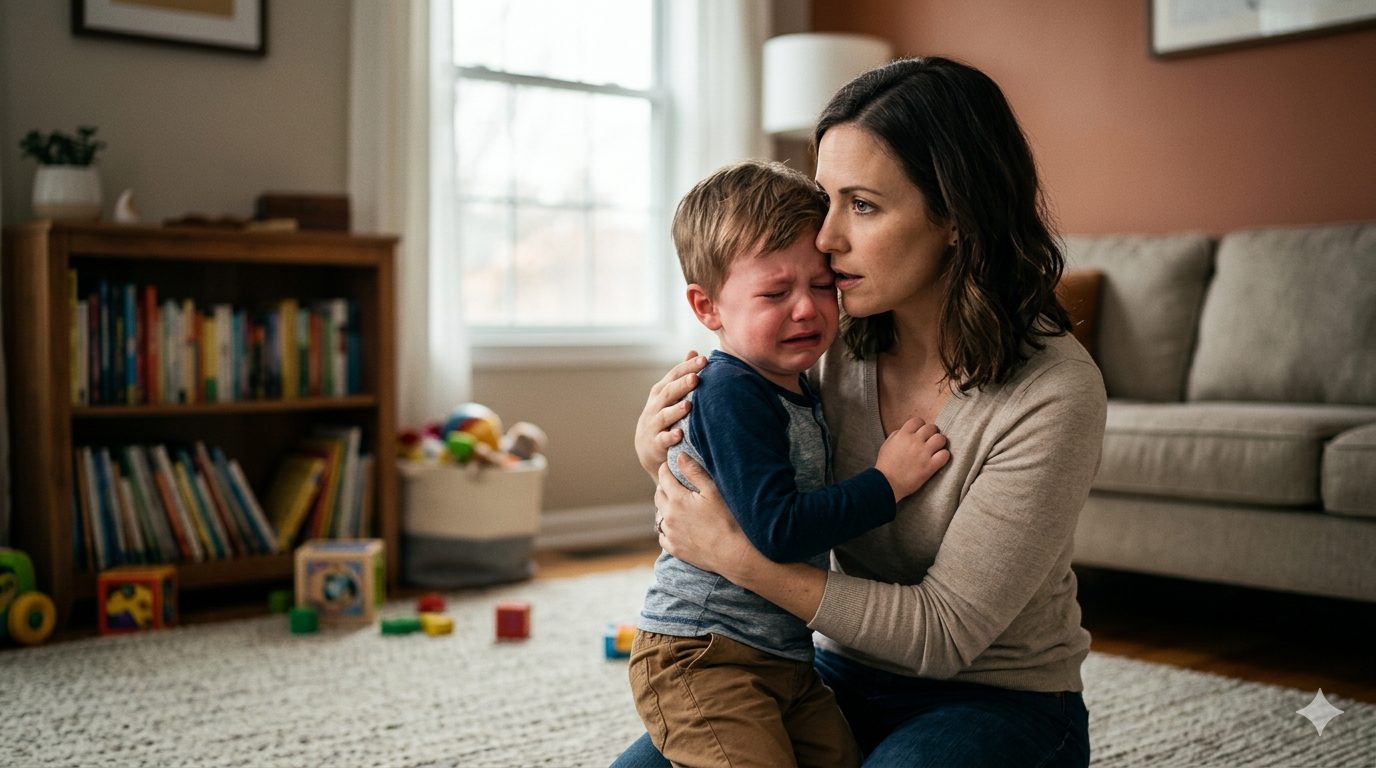
There’s a particular kind of moment that tends to sneak up on parents. It might look small from the outside—a toy taken, a goodbye at drop-off, a spilled cup—but suddenly your child’s whole world tilts. Tears come fast. Voices rise. Logic quietly exits the room.
And there you are, standing at the edge of a very big feeling in a very small person. These moments can feel overwhelming, but they are also something else: the beginning of emotional learning. And while they represent a challenge in the immediate moment, they are also an opportunity to help your child process the big moments they aren’t prepared for yet.
🌱 The First Draft of Feelings
Preschoolers are just starting to build what psychologists call emotional regulation—the ability to understand and manage feelings. But early on, those skills are still under construction.
Research in early childhood development shows that young children experience emotions intensely but don’t yet have the tools to process or express them clearly. So when your child melts down because someone else is using the blue marker, it’s not really about the marker.
It’s about:
- Disappointment
- Lack of control
- Not yet having the words to say, “That mattered to me”
To adults, it’s a moment. To them, it’s the whole sky.
🧭 What Children Need in These Moments
When emotions run high, children aren’t looking for explanations or corrections right away. They’re looking for connection.
One widely supported approach in child psychology, often called emotion coaching, suggests that children learn best when adults first acknowledge feelings before guiding behavior. Research by John Gottman and colleagues found that this approach helps children develop stronger emotional awareness and self-regulation over time.
In practice, that can look surprisingly simple.
🧩 Small Words, Big Impact
Here are a few gentle ways to respond in the moment:
- “That was really important to you.”
- “You didn’t like that.”
- “It’s hard when things don’t go the way you wanted.”
- “I’m right here with you.”
These phrases don’t “fix” the feeling. They make space for it. And that space is where learning begins.
🛠️ After the Storm: Teaching Comes Later
In the middle of a meltdown, a child’s brain is in survival mode. Reasoning, problem-solving, and listening take a back seat. But once the storm passes—once breathing slows and the world feels steady again—that’s when you can gently build skills.
You might say:
- “Next time, you can say ‘I’m still using that.’”
- “Let’s think of another way to solve that problem.”
- “What could we try if that happens again?”
- “Would you like to know what other kids do/say when they are upset?”
This is where children begin connecting feelings to actions.
🌿 The Power of Naming Feelings
One of the simplest, most powerful tools you can offer is language. Studies suggest that naming emotions helps children begin to regulate them—a process sometimes called “name it to tame it.”
You might notice:
- “You look frustrated.”
- “That felt disappointing.”
- “You were excited, and then it changed.”
Over time, children start borrowing this language. And eventually, they begin to use it on their own.
🧺 What This Looks Like in Real Life
Of course, real life rarely unfolds in calm, picture-perfect moments.
Sometimes:
- You’re late
- The grocery cart is half full
- The meltdown is happening in public
And in those moments, “perfect” responses aren’t the goal. Consistency is. Even one small, steady phrase—“I’m here”—repeated over time, becomes something your child can rely on.
🌄 Growing Through the Firsts
Preschoolers experience so many “firsts”:
- First friendships
- First conflicts
- First goodbyes
- First moments of feeling misunderstood
Each one brings a wave of emotion. And each one is also a chance to learn:
- Feelings can be handled
- Big emotions are not dangerous
- Someone safe will stay nearby
🌼 A Gentle Reframe
It’s easy to see emotional moments as disruptions. But they are also rehearsals.
Each tearful moment, each frustrated stomp, each “I can’t!” is part of your child practicing how to be human. And your role isn’t to eliminate those feelings. It’s to walk alongside them as they learn to carry them.
If you’d like to discuss a place for your kids at Creekside Kids, click this embedded link to schedule an appointment. Let’s get to know each other! Like us on Facebook to follow our stories for news and updates. We’re located at 1201 W Cheyenne Road, Colorado Springs, CO 80906, and we can be reached at (719) 635-9111. Our hours of operation are 6:45 a.m. to 5:45 p.m., Monday through Friday.
📚 References & Inspiration
- Center on the Developing Child, Harvard University — Emotional Development in Early Childhood
- The Whole-Brain Child by Daniel J. Siegel and Tina Payne Bryson
- Raising an Emotionally Intelligent Child by John Gottman
- American Academy of Pediatrics — Guidance on emotional development and regulation in early childhood
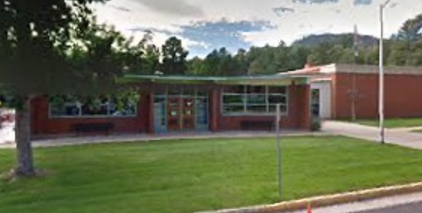 1201 W Cheyenne Rd