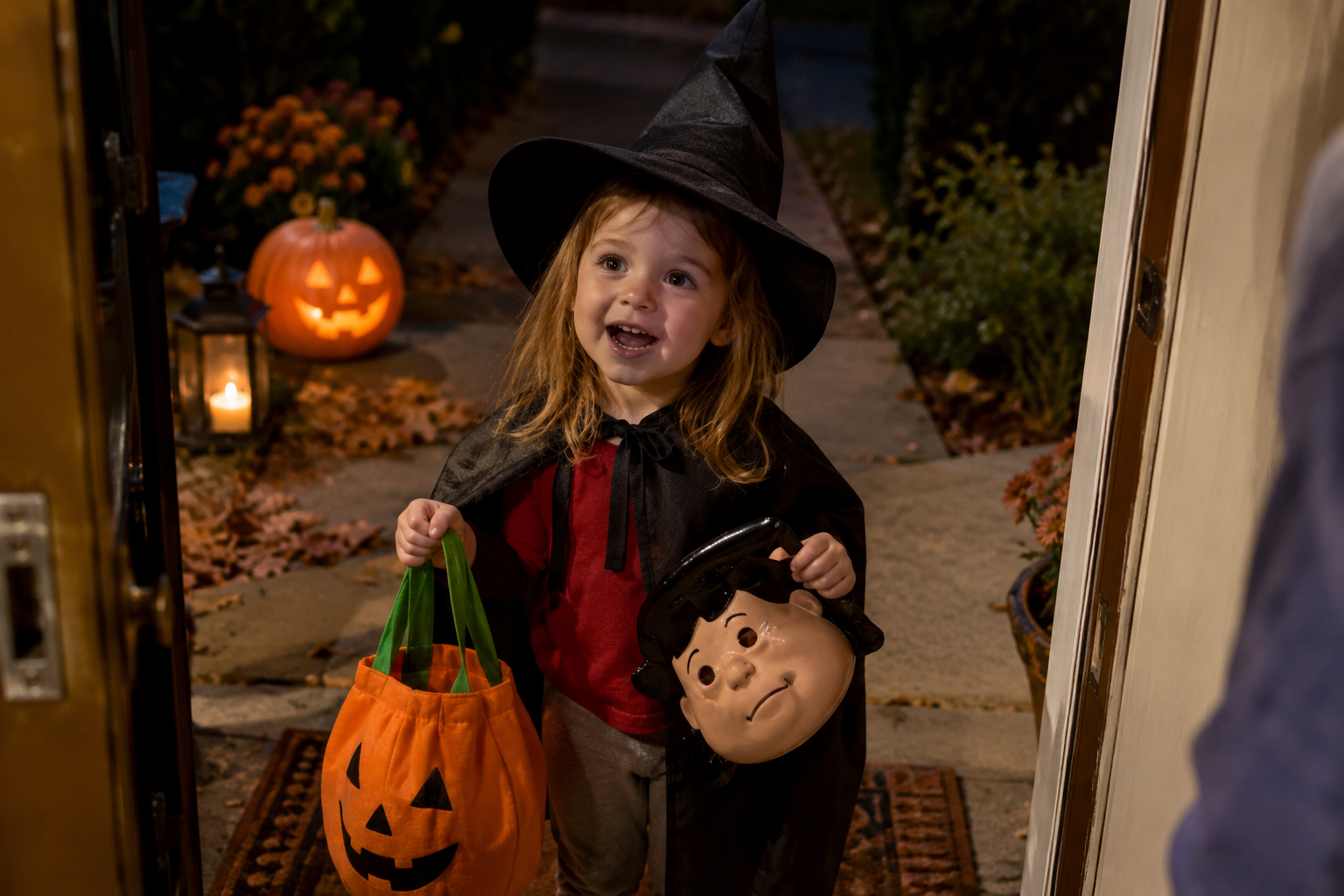
When Halloween Is a Lot for Little People
Back in May, we talked about “Tiny Feelings, Big Lessons” and the enormous emotions that can grow out of very small preschool moments: the wrong cup, a toy that gets taken, goodbye at drop-off, or a snack that doesn’t look the way it was supposed to.
Halloween takes that same emotional landscape and adds costumes, candy, decorations, strange noises, crowds, darkness, and approximately 47 opportunities to hear the phrase, “But I wanted to do it MYSELF!”
For young children, Halloween can be wonderful. It can also be a lot. And sometimes the biggest Halloween challenge isn’t the child who is afraid of the decorations. It’s the child whose parents love Halloween so much that they’ve accidentally planned the experience for a 35-year-old version of their child.
The Parent Who Has Been Waiting All Year
Some parents really love Halloween. Not “I buy a pumpkin in October” love. We’re talking about the people who have a Halloween playlist, a favorite spooky movie, a box labeled HALLOWEEN that somehow contains three additional boxes labeled HALLOWEEN, the 12-foot skeleton from Home Depot (or more than one!), and strong opinions about whether a pumpkin should be carved before or after October 15.
If that’s you, excellent. Halloween is supposed to be fun, and I congratulate you on still loving it so dearly, and on passing those rituals down to the next generation. But it’s vital to remember that preschoolers are still discovering what fun means to them. Your child may eventually become the kid who wants to spend all of October decorating the house, dressing as something increasingly elaborate, and arguing passionately about the proper amount of fake spiderweb…
…or they may decide that pumpkins are terrific but costumes are suspicious. They may love ghosts, but hate masks. They may adore trick-or-treating, but want to go home after six houses. They may spend three weeks insisting they are going to be a dragon and then burst into tears when the dragon costume actually goes on.
That isn’t necessarily a failed Halloween. It may simply be their Halloween. Or, their first social-emotional understanding of Halloween.
The American Academy of Pediatrics recommends preparing young children for Halloween, practicing with costumes, watching for fears and anxieties, and being willing to stop early if the experience becomes too much. It even notes that if a young child doesn’t want to participate, that’s okay. There is always next year, and a year can make a surprisingly big difference at this age.
So if you’re a serious Halloween person, here’s the challenge: Don’t give your child your Halloween. Allow them to discover Halloween on their own. You can provide the pumpkins, the costumes, the decorations, and the spooky playlist. Then let your child decide which parts become magical.
The Halloween Paradox
This is the child who has been asking for a costume for three weeks.
“I want to be a witch!”
“Absolutely.”
“I want the hat!”
“Great.”
“And the cape!”
“Perfect.”
“And the broom!”
“We can do that.”
Then, Halloween arrives. The hat is wrong. The cape feels weird. The broom is too long. The shoes don’t match. And suddenly your tiny witch is lying on the floor screaming that HALLOWEEN IS RUINED. It is tempting to respond with: “But you wanted this!” Unfortunately, preschool brains don’t always care about the evidence.
The excitement of imagining something and the reality of experiencing it are different. A child can desperately want to dress up and then become overwhelmed once the costume is actually itchy, hot, restrictive, unfamiliar, or simply different from what they imagined.
This is where the same emotion-coaching approach from our May article comes in. Instead of immediately trying to solve the problem, start by acknowledging the feeling:
“You really wanted to wear this costume.”
“It doesn’t feel the way you thought it would.”
“You’re disappointed.”
Once the storm settles, you can figure out whether the cape needs adjusting, the costume needs changing, or the dragon needs to become a very comfortable dragon wearing sweatpants.
That’s not giving in. It’s helping a young child understand what is happening inside them.
Too Much Fun Can Still Be Too Much
Halloween is exciting, and that’s part of the problem.
Shared excitement is still a form of bonding, and young children are not always equipped to regulate a whole evening of it. There may be a preschool party in the morning, decorations everywhere, unfamiliar costumes, loud music, candy, neighborhood activity, a disrupted bedtime, and a parent who has been announcing for six weeks that TONIGHT IS THE NIGHT. A child can be having a wonderful time and still reach their limit.
That’s why preparation matters.
Talk about what will happen. Practice wearing the costume before Halloween. Explain that the scary-looking things are pretend. Think about when your child normally gets tired. Have a plan for going home. And don’t be afraid to use the plan.
The American Academy of Pediatrics (AAP) specifically recommends preparing young children for Halloween and being ready to pack it in early if a child becomes overwhelmed. In other words: You are allowed to leave the party before the child becomes a pumpkin-shaped emotional emergency.
But It’s Just a Costume!
To an adult, the vampire at the door is obviously Dad’s friend wearing a cape. To a preschooler, the information may be considerably less obvious.
Young children are still developing their understanding of appearance, reality, and pretend. Masks and costumes can make familiar people suddenly look unfamiliar, which can be confusing and frightening. ZERO TO THREE notes that young children can have difficulty reconciling unusual appearances with their understanding of what people normally look like.
So if your child backs away from Uncle Bob because Uncle Bob has transformed into a six-foot werewolf, “It’s just Uncle Bob!” may not solve the problem right away.
Try:
“That’s Uncle Bob under the costume.”
“You don’t have to go close.”
“We can watch from here.”
You don’t have to convince your child that something isn’t scary. You can help them feel safe while they decide what they think about it. Sometimes, that means approaching slowly. Sometimes, it means waving from across the room. Sometimes, it means spending the evening nowhere near Uncle Bob’s werewolf head. All three are legitimate Halloween strategies.
The Great Costume Meltdown
Then there is the costume itself. Parents see the adorable finished product. Children experience the tag. The zipper. The hat. The tights. The itchy seam. The bathroom logistics. The impossibility of sitting down. The fact that apparently nobody considered how difficult it would be to walk like a dinosaur while wearing dinosaur feet.
The AAP recommends trying costumes ahead of time and having a backup plan. It also recommends avoiding costumes that are too long or bulky for young children.
This is one place where enthusiastic parents can save themselves some heartache. Test the costume before Halloween. Let your child run in it. Sit in it. Use the bathroom in it. Wear the hat. Take the hat off. Try the whole thing again.
And if the grand costume you’ve lovingly assembled turns out to be deeply unpopular, remember: the goal is not to create the perfect photograph for the family scrapbook. The goal is for your child to have an experience they can enjoy. Sometimes the most successful costume is the one that stays on.
When the Candy Isn’t Really the Problem
Eventually, Halloween ends. This is frequently when things get interesting.
Your child has collected candy. They have walked farther than usual. They’re tired. They’re overstimulated. Their routine is gone. And now an adult dares to announce: “Okay, we’re going home.”
This can produce a reaction of biblical proportions. But the screaming may not really be about the candy. It may be about disappointment. It may be exhaustion. It may be the sudden transition from an extremely stimulating experience back to ordinary life. And it may be all three.
This is another opportunity to use the approach we talked about in May:
“You really wanted to keep going.”
“It was fun, and now it’s time to go home.”
“You’re disappointed.”
“I’m right here.”
The feeling can be completely valid while the boundary remains completely intact. Halloween doesn’t have to continue because your child is unhappy that it is ending. They can be disappointed. You can understand the disappointment. And you can still go home.
Let Halloween Be Whatever Halloween Is
This may be the hardest part for parents who genuinely love the holiday.
You have memories. You have traditions. You have ideas. You may have spent hours imagining your child experiencing Halloween exactly the way you did.
But your child isn’t a miniature version of you.
Maybe they love the costumes. Maybe they love the candy. Maybe they love carrying a pumpkin bucket around the neighborhood but aren’t remotely interested in trick-or-treating. Maybe they want to decorate every pumpkin in sight. Maybe they want to watch It’s the Great Pumpkin, Charlie Brown seventeen times. Maybe they want to wear pajamas and eat popcorn while everyone else goes out.
And maybe this year they are simply not ready.
That’s okay. The point isn’t to manufacture a perfect childhood memory on October 31. It’s to give your child enough safety, freedom, and support to begin making their own memories. That’s especially important for parents who have a serious love affair with Halloween. Your enthusiasm can open the door. It doesn’t have to decide what happens after your child walks through it.
Tiny Feelings, Bigger Costumes
Back in May, we talked about how preschoolers are practicing what it means to have feelings that are sometimes much bigger than their ability to manage them.
Halloween gives them a remarkable collection of feelings to practice with. Excitement. Fear. Anticipation. Disappointment. Pride. Overwhelm. Surprise. And sometimes the very confusing experience of saying, “I REALLY wanted this,” followed immediately by, “I HATE THIS.” That’s part of growing up.
Our job isn’t to make every feeling disappear. It’s to help children experience those feelings while knowing that someone safe is there with them.
So this Halloween, enjoy the costumes. Carve the pumpkins. Put out the decorations. Take the pictures. Play the spooky music. Just leave a little room in the celebration for your child to surprise you. The thing they love most may not be the thing you expected.
And if the evening goes sideways? You can always take off the costume, turn down the lights, get comfortable, and say: “I’ve got you. Let’s take a break.” Sometimes that is exactly what a tiny person in a very big costume needs.
If you’d like to discuss a place for your kids at Creekside Kids, click this embedded link to schedule an appointment. Let’s get to know each other! Like us on Facebook to follow our stories for news and updates. We’re located at 1201 W Cheyenne Road, Colorado Springs, CO 80906, and we can be reached at (719) 635-9111. Our hours of operation are 6:45 a.m. to 5:45 p.m., Monday through Friday.
Sources and Further Reading
- CREEKSIDE KIDS: “Tiny Feelings, Big Lessons: Helping Preschoolers Navigate Their First Big Emotions”
- American Academy of Pediatrics / HealthyChildren.org: “Easing Babies & Toddlers into Halloween Fun: 8 Tips for Parents”
- ZERO TO THREE: Resources on young children’s fears, emotional regulation, and responding to overwhelming experiences… developmental guidance on young children’s understanding of appearance, reality, and unfamiliar costumes or characters.
- Check out our older October blogs from Creekside Kids that you may have missed!
- Read “Autumn Magic”, for ideas about chilly weather fun in Colorado Springs.
- Check out “Keeping Halloween Fun and Safe for our Little Ones”, for safety tips on trick-or-treating in the ‘Springs.
- “Instilling a Love of Autumn in your Children” has some good ideas for parents anxious to share the fun of the season.
- “Explaining Halloween to your Kids” can help you show your kids that these rituals of fun have a gentle, benign meaning to them.
- “Why Playing With Costumes is Good for Children” is for parents who may be a little unsure if costumes on children are a good idea.
- Wondering about the issues of letting kids play as Batman or The Hulk? “Superheroes at Play” dives into the pros and cons of letting kids be their favorite hero (or villain).

 1201 W Cheyenne Rd